The young waiter doesn’t just buy the motorcycle, he dismantles it within hours, spreading every gear and piston across the floor of 1910s Coimbatore. In that single act, Krishnakumar Ramakumar’s G.D.N. announces its hero’s defining instinct: the urge to understand before he can own.
From there, this Tamil biopic traces the extraordinary life of G.D. Naidu, the self-taught inventor and entrepreneur who built India’s first indigenous electric motor and a bus cooperative that defied colonial bureaucracy. It’s a story worth telling, and Madhavan makes it worth watching, though the film’s reverence occasionally blunts its edge.
Madhavan’s Four-Decade Grip on a Man Who Refused to Stay in His Lane
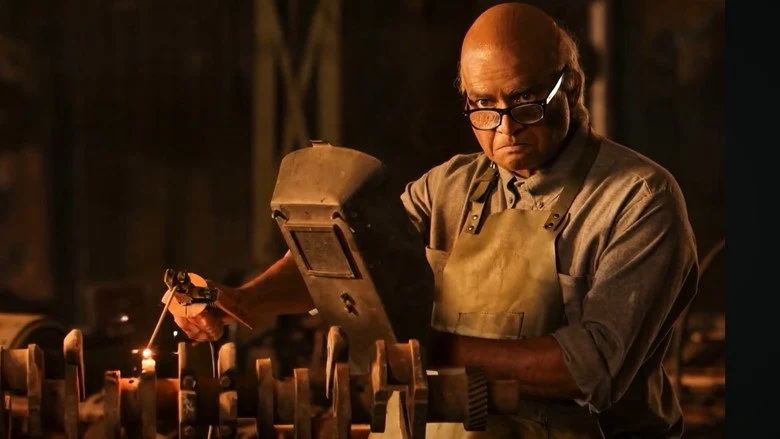
Madhavan remains the sharpest man in every room his character argues in, from colonial tax offices to post-independence courtrooms. Watching him age from ambitious waiter to weathered industrialist, the actor never loses the coiled intensity that made his Rocketry turn so memorable.
His G.D. Naidu is stubborn, brilliant, and occasionally hubristic, a man who abandons his first marriage and chases wartime opportunities in Hitler’s Germany without apology. The performance carries four decades of accumulated ambition and regret in a single furrowed brow.
This is Madhavan’s second rescue act for an unsung Indian innovator, and he brings the same conviction that made Nambi Narayanan’s story sing. He makes you believe that one man’s obsession with how things work could genuinely change a nation’s industrial fate.
A Director Who Trusts His Material, But Races His Calendar
Krishnakumar Ramakumar doesn’t sanitize his subject. He shows Naidu’s flaws, the abandoned marriage, the pride that invited tax battles, and trusts the story to survive its blemishes. That’s a confident directorial choice, rare in a genre that usually worships its heroes without question.
But the screenplay’s linear structure leaps across decades too quickly, never letting emotional moments settle before the next era arrives. The first half establishes Naidu’s early life and inventions capably; the second half rushes through independence and its aftermath with less patience for consequence.
Ramakumar’s best stretch is the formation of the UMS bus cooperative, where rival operators become allies under Naidu’s vision. It’s here the film finds its rhythm, business as obsession, cooperation as rebellion, before losing it again in the rush toward legacy.
Jayaram’s Paperwork-Worshipping Nemesis and Sathyaraj’s Second Barrel
Jayaram plays Ambalapara Krishnan, a tax officer who worships paperwork and becomes Naidu’s most persistent opponent. It’s a deliciously antagonistic turn, the bureaucrat as worthy adversary, matching the inventor’s stubbornness with bureaucratic zeal.
Sathyaraj has a fine time as Ramiah Pillai, though the writing uses him as a second barrel for the hero’s punchlines rather than a fully realized character. Still, his auction moment lands with quiet power, buying Naidu’s seized assets for a rupee and three annas when the town refuses to bid.
Dushara Vijayan plays Ranganayakiammal, Naidu’s second wife, as a woman built to outlast a siege. Karunakaran appears in a villainous turn, a welcome departure from his usual comic relief register.
The Auction Scene That Says Everything, And The Sepia That Says Too Much
The film’s most praised sequence is the auction of Naidu’s seized assets, where the entire town refuses to bid in silent solidarity. It’s a devastating image of community loyalty, undercut only by the kinsman’s token purchase, a moment that captures the film’s complicated relationship with its hero’s legacy.
Arvind Kamalanathan’s cinematography serves the proceedings capably, but the heavy colour grade flattens 1930s-40s Coimbatore into one continuous sepia mood. The period recreation suffers for it, losing the texture that could have grounded the historical setting.
Govind Vasantha’s score supports without dominating, though no specific musical moments stand out in the available accounts. The editing mirrors the screenplay’s pacing problem, rushing where it should linger, particularly in the independence-era sequences.
The opening textbook committee debate, arguing whether Naidu belongs in school syllabi, frames the film’s central question: how do we remember the innovators we didn’t canonize? It’s a smart structural choice, even if the film never fully interrogates its own admiration.
For more Tamil biographical dramas and critical takes on regional cinema, browse our Tamil Drama reviews.
A Film That Admires Too Much to Take Apart
The Times of India’s 3.0/5 rating captures the film’s central tension: it builds a legend and sells it in the same sitting, without deeper interrogation of its subject’s contradictions. The publication’s line about Naidu, that his instinct was to take apart whatever he admired, applies uncomfortably to the film itself, which admires him too much to try the same.
Early viewers call it an inspiring biopic on a forgotten pioneer, with Madhavan’s performance and Ramakumar’s direction drawing consistent praise. The social media sentiment is positive, though the film’s box office fate remains unclear in the days following its August 7, 2026 release.
What’s missing is the critical distance that could have elevated this from respectful tribute to essential cinema. The film’s flaws, rushed decades, flattened period detail, are real but not fatal, and I found myself wishing it trusted its subject’s complexity as much as it trusts his genius.
For a similar portrait of an unsung innovator fighting institutional resistance, revisit DC review, another Tamil drama that gambles on a star-studded canvas.
See G.D.N. on the big screen if you’re a fan of biographical dramas about Indian innovators, the regular theatrical format suits its scale best. You’ll leave with admiration for Naidu’s relentless curiosity, even if you wish the film had dismantled him the way he dismantled that motorcycle.
G.D.N. earns a measured 3 out of 5, worth your time for Madhavan’s performance and a story that deserves telling, but a biopic that needed more courage to take its hero apart.
For another political loyalty test wrapped in Tamil drama, explore Oru Kaalathil verdict.