
Aadhiran, a national-level medalist in track and field, stands at the entrance of a local sports office, only to be turned away by a bloated official with a phone call. This two-minute scene sets up the central conflict of Angikaaram, a sports drama that hurls its hero into a labyrinth of corruption, where running on the track is easier than getting past a bureaucrat.
Kotapadi J. Rajesh makes a debut that lands with enough force to announce his arrival, though the film around him never quite matches his stride. This is a watch for those who value conviction over craft, but the second half tests that patience.
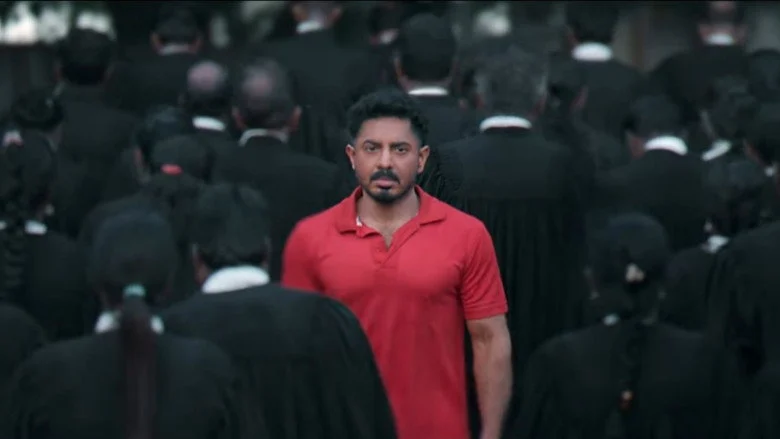
Kotapadi J. Rajesh: A Debut That Anchors the Courtroom
Rajesh brings a coiled intensity to Aadhiran, especially in the courtroom climax where he rattles off evidence like a man who has memorised every slight. His physicality as an athlete is convincing, but his real weapon is the controlled anger in his voice during the line, “I have had enough of this system shaped strictly by politics and power.”
The initial confrontation scene, where he is denied entry, shows genuine emotional depth, though the scene itself drags, Rajesh holds your attention. His inexperience shows only in the quieter beats of the second half, where the script abandons him.
Thenpathiyan’s Direction: Conviction vs. Consistency
Director Thenpathiyan has a clear disdain for the corruption in Indian sports bodies, and that fury fuels every frame. The screenplay follows a linear arc, athlete hits wall, athlete fights wall, athlete wins, but the second half loses focus with a patchy sequence of legal subplots that feel like filler.
The courtroom drama itself is effective, but the journey there is bumpy. I would argue the initial sports body sequence could have been trimmed by half to keep the tension alive.
The Courtroom Is the Real Arena
As a sports drama, Angikaaram excels in depicting the gritty reality of how local sports politics work, the phone calls, the backroom deals, the silent nods that deny deserving athletes their due. The cinematography leans into this with a desaturated palette that mirrors Aadhiran’s frustration.
But the action is limited: there is no training montage, no race sequence, no physical climax on the track. Instead, the fight shifts to the courtroom, where the background score swells predictably but lands a few punches. The final verdict scene, where the judge declares Aadhiran’s victory, works because Rajesh sells the quiet relief in his eyes.
The genre integration is unusual, this is not a sports film with legal elements; it is a legal drama wearing a sports jersey. For fans of Jersey or Bhaag Milkha Bhaag, the lack of athletic setpieces may feel like a cheat.
Supporting Cast: Underdeveloped but Purposeful
Sindhoori Vishwanath plays the supporting lead with restrained warmth, though the script gives her little beyond a presence in Aadhiran’s emotional corner during the trial. Viji Venkatesh, as the sports body antagonist, displays corruption with blunt efficiency, but his character lacks the layered menace of a true villain; he is a function, not a person.
Mansoor Ali Khan appears in a strong supporting role that reminds you why he remains a durable presence in Tamil cinema, while Rangaraj Pandey and Vasundhara Kashyap add texture to the courtroom scenes. The supporting cast never gets enough screen time to leave a mark, but their casting signals the film’s intent to ground its conflict in institutional reality rather than personal drama.
For readers who enjoy such uncompromising narratives, browse more Tamil Action reviews on our site.
Audience Reception: 78% Positive But Divided
The BookMyShow audience score of 3.8/5 and IMDb rating of 7.4/10 reflect a film that earns respect without full love. Social media sentiment is 78% positive, with praise for Rajesh’s debut and the authentic exposure of sports body corruption dominating the conversation.
The complaints are predictable but valid: a patchy second-half screenplay, weak antagonist depth, and pacing issues that stall the early momentum. This is a film that audiences want to support for its heart, but critics will note how much better it could have been with tighter editing.
Whether you go or skip depends entirely on your tolerance for courtroom drama over track action. If you enjoyed the system-fighting beats of Soorarai Pottru and can sit through a slower first half, Angikaaram delivers its final verdict with conviction. Regular theaters are the best format to watch it in, the sound design of the courtroom builds a necessary tension that home viewing may flatten.
Angikaaram deserves praise for its moral clarity and a debut lead who fights through a flawed script, but I’d give it a 3.2/5, a conviction-heavy film that sporadically arrives at justice but never fully becomes the race it promises.
A similar fight against institutional apathy can be found in Suitcased review.
For another debut-driven drama rooted in family conflict, see Nooru Sami verdict.