
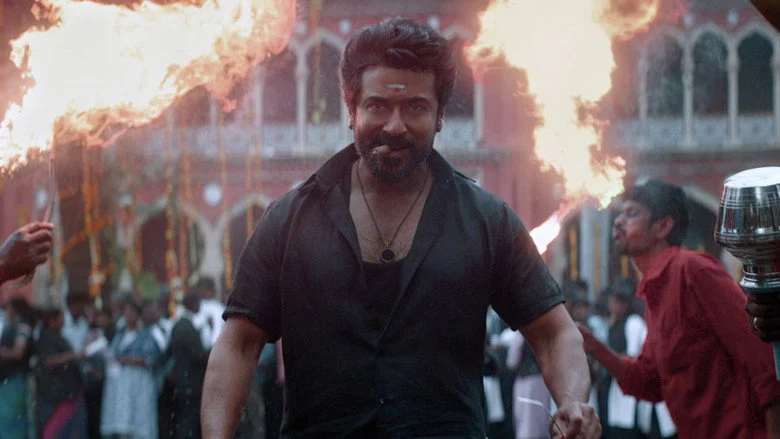
The moment Saravanan’s eyes glaze over and his posture shifts from weary lawyer to unearthly force, you sense it, this is where the film earns its mythological billing. Suriya doesn’t just act possessed; he recalibrates his entire physicality, moving with a stiff, deliberate authority that feels genuinely otherworldly. It’s the single scene where the fantasy and judicial threads finally lock into place, and it carries the film through its weaker stretches.
Before that transformation, the setup is functional but familiar: a father-daughter duo robbed and trapped by a predatory legal system. The premise is ripe for rage, yet the screenplay rushes past their vulnerability to get to the divine intervention. Suriya’s human-half is sketched with enough nuance to sell the shift, but one wishes the script had given him room to earn the possession.

RJ Balaji Directs With Pace but Cuts Corners on Emotion
RJ Balaji keeps the engine revving, the film never drags, and the first half snaps along with brisk confidence. He knows how to weave action, fantasy, and courtroom theatrics into a single coherent genre stew, and that’s no small feat for a directorial debut in this register. But his weakness is visible in the middle act, where plot transitions feel abrupt and emotional beats are sacrificed for velocity. The father-daughter bond, meant to be the film’s heart, is treated more as a plot device than a relationship worth investing in. The screenplay follows a linear, clear arc but could have used a few more moments of quiet to let the stakes breathe.

The Film Puts Fantasy Over Judicial Realism, and That’s a Choice
The courtroom confrontation with Baby Kannan is where this duality becomes most glaring. Balaji stages it as a high-stakes verbal duel, but the reliance on supernatural explanation undercuts the tension, why fear a legal system that can be dismantled by divine fiat? The scene lacks the procedural grit that makes courtroom drama compelling, and critics who expected A Few Good Men in veshti will leave disappointed.
On its own terms, however, the action choreography works well. The climax unleashes Karuppusamy’s power in visually inventive ways, lighting shifts, color contrasts, and a physicality that sells the superhuman. The background score elevates every punch and pronouncement, giving the proceedings a devotional-metal energy that fits the madness. As a blend of mass entertainment and mythological spectacle, the film lands its target; as a judicial thriller, it cheats.
Still, there is craft in how RJ Balaji integrates the deity’s presence into the visual language. The possession scene and climax use cinematography to make the divine feel tactile, not just a plot device but a spatial force. For audiences willing to suspend disbelief, the fantasy genre execution is confident and coherent, if occasionally excessive.
Trisha and Yogi Babu Hold the Film’s Human Core
Trisha Krishnan does not have a large role, but she brings a grounding warmth that the film needs. Her reactions to Saravanan’s transformation add a layer of emotional texture that the screenplay itself didn’t build. She is the audience’s proxy, human, confused, and ultimately reverent. Yogi Babu and Swasika deliver supporting performances that anchor the film’s traditional tone. Swasika, playing the father, carries the vulnerability that the first act hinges on, even if the writing doesn’t give her enough scenes to deepen it. Yogi Babu provides the comic relief without derailing the tone, which is harder than it looks. Their presence signals that the film wants to stay connected to community and faith, even when the action goes superhuman.
If you enjoy this mix of myth and legal drama, there is plenty more to explore in our growing collection of Tamil action reviews.
Audience Cheers But Critics Remain Divided on the Fantasy-First Approach
The audience at BookMyShow has scored this an 8.5/10, and social media sentiment tilts 78% positive. The possession scene and climax have become talking points, with fans celebrating the sheer audacity of turning a courtroom into a temple. But the Rotten Tomatoes critic aggregate of 6.5/10 tells a more measured story. Reviewers have praised Suriya’s dual performance and Balaji’s pacing, but they’ve also pointed out the underdeveloped antagonist and the abrupt emotional subplots. The film is a hit by audience metrics, yet the gap between popular reception and critical approval suggests a divide in expectations, mass audiences get exactly what they want, while cinephiles may feel the fantasy overrides the drama.
Should You Watch It?
Go for Suriya’s transformation scene and the sheer kinetic energy of the climax, they are worth the ticket price on an IMAX screen. But if courtroom logic or nuanced character arcs matter to you, this will feel like a shortcut rather than a journey. See it as a mass entertainer with a divine twist, not a tight drama. Karuppu is a committed, visually ambitious swing that earns a solid 3 out of 5, worth watching for its lead’s conviction, but not its script’s coherence.
For a more grounded take on justice and intensity, check out Kara’s slow-burn approach.
Readers looking for more tamil action reviews can explore them on Isaimini.
If Suriya’s energy here worked for you, Love Insurance Kompany offers a different kind of lead-driven momentum.