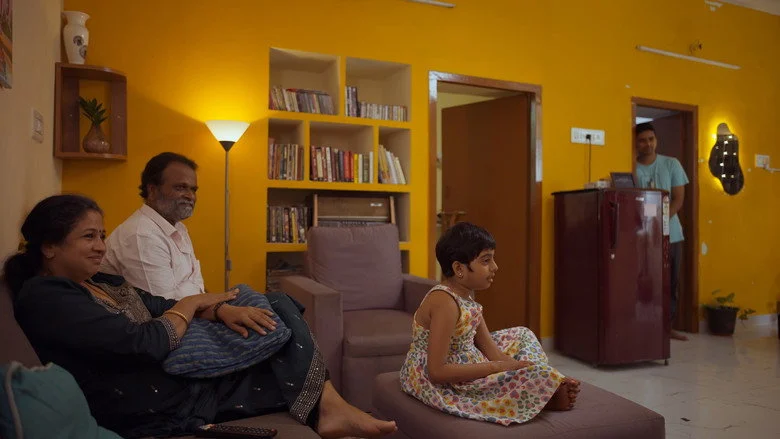
A woman in a white coat is bludgeoned to death in a sterile hospital lab, the fluorescent lights flickering silently as the network of crime tightens around her. This ugly, crucial moment, meant to be the film’s explosive trigger, lands with a thud, poorly staged, clunkily edited, it announces a thriller that is far more invested in its destination than its journey.
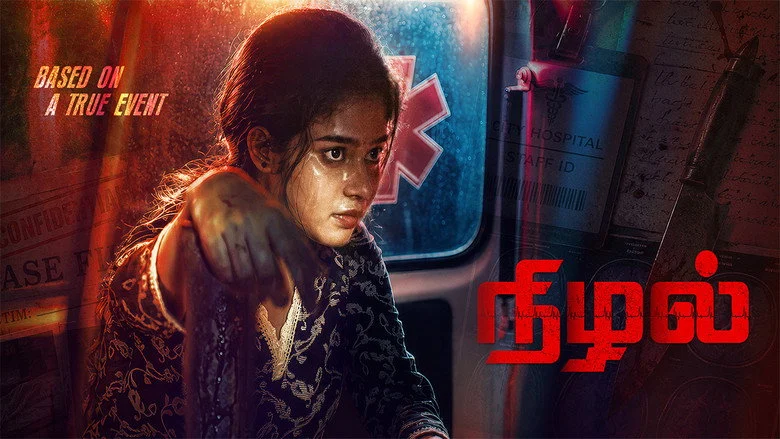
Janany Gunaseelan: The Single Searing Light in the Dark
In the role of Ramya, the twin who survives a gang attack, Janany Gunaseelan emerges as the film’s only wholly successful element. She successfully conveys the raw, terrified disorientation of a woman who has witnessed a horror that shatters her reality.
Her emotional resilience in the aftermath, and the slow burn of grief turning into grim determination in the second act, feels more organic than the script that carries her. Dinamalar rightly noted that there is “no plus except Janany in a trainee doctor role, ” and one can see why, she glues together a film that often threatens to fall apart at its seams.
AK Kumar’s Screenplay: Where Ambition Meets Execution’s Wall
Director AK Kumar has a clear emotional core: the bond between twin sisters Ramya and Saranya (Kaushik Gopalan) pushed to its breaking point by a brutal crime. The linear progression from trigger (murder) to confrontation sounds sturdy on paper, but Act 1 suffers from a clunky narrative that fails to build the required dread.
The film’s biggest flaw is its rushed transition into Act 2, which leaves the audience as confused as the police force should be. The villain Guna’s organization remains an underdeveloped sketch, a vague “powerful system” that lacks the specific menace needed to make the stakes feel real.
When a Revenge Thriller Forgets Its Own Kill-Switch
As a crime thriller, *Nizhal* depends entirely on the murder of Lakshmi as a narrative trigger. The scene is meant to shock, but the clunky staging saps it of its intended power, leaving the film desperately trying to regain its footing.
Where the film does find its rhythm is in Act 2’s investigation sequences. Here, the pacing tightens as sub-inspector Raghu (Vishakan) uncovers the truth linking Guna to the murders, but even this section relies heavily on dialogue that telegraphs its themes: “a tense struggle between justice, duty, and personal allegiance.”
The climax, Saranya’s direct confrontation with the killers, delivers the adrenaline shot the rest of the film needs. It is intense, provides a clear resolution of justice, and almost makes up for the tepid build-up, though the film’s over-reliance on clichéd revenge tropes prevents it from feeling fresh.
Gopalan, Vishakan, and the Fog of Incomplete Portraits
Kaushik Gopalan, playing the other twin Saranya, is tasked with carrying the film’s fury. She effectively portrays that burning resolve during the Act 3 showdown, but her character arc feels sketched rather than fleshed out, leaving her as a vessel for revenge rather than a person.
Vishakan as Raghu, the duty-bound sub-inspector, is a solid presence in the investigative scenes, but his internal conflict between law and love is reduced to a few lines of by-the-numbers dialogue. It is a performance that signals the film’s intent to explore moral grey zones, but the screenplay never allows him to actually navigate them.
Audience Reception: A Mid-Range Verdict That Rings True
With no major controversies to its credit, *Nizhal* lands as an “average” verdict from available sources. Audiences praise the emotional depth of the twin sisters’ journey and the satisfying climax, while consistently pointing complaints at the weak first-half pacing and predictable storyline. Cinema Express summed it up neatly: “Clunky narrative, incomplete arcs holds back this thriller.”
This is a film that knows its climax is strong and rushes to get there, but forgets that the audience needs to care about the people in the car before the crash. For a film running just 1 hour 41 minutes, the slow patches feel even more egregious because they waste screen time that could have been used to flesh out Guna’s organization or Raghu’s moral dilemma.
For cinephiles wanting to explore more uneven but ambitious Tamil crime stories, a deep dive into Tamil Thriller reviews is a worthwhile next step.
Should You Watch Nizhal?
If you are a fan of Janany Gunaseelan, this is the only argument for a ticket, she carries the film on her shoulders and does not drop it. For everyone else, the predictable path and clunky mechanics of the first half make it a difficult sit, even if the last twenty minutes offer a solid release. Watch it on a streaming service where you can skip the first forty minutes.
Nizhal has a single compelling performance, but its tired structure and shallow character work hold it back to a lukewarm 2 out of 5.
For a tighter, more character-driven Tamil crime film that doesn’t stumble on its own plot mechanics, Moondram Kan review offers a far more rewarding watch.
Meanwhile, for a more straightforward comedy that also struggles with its second act, Double Occupancy verdict makes for an interesting contrast in structural weakness.